

From struggle to strength: Rose’s fight for family and education
July 11, 2023
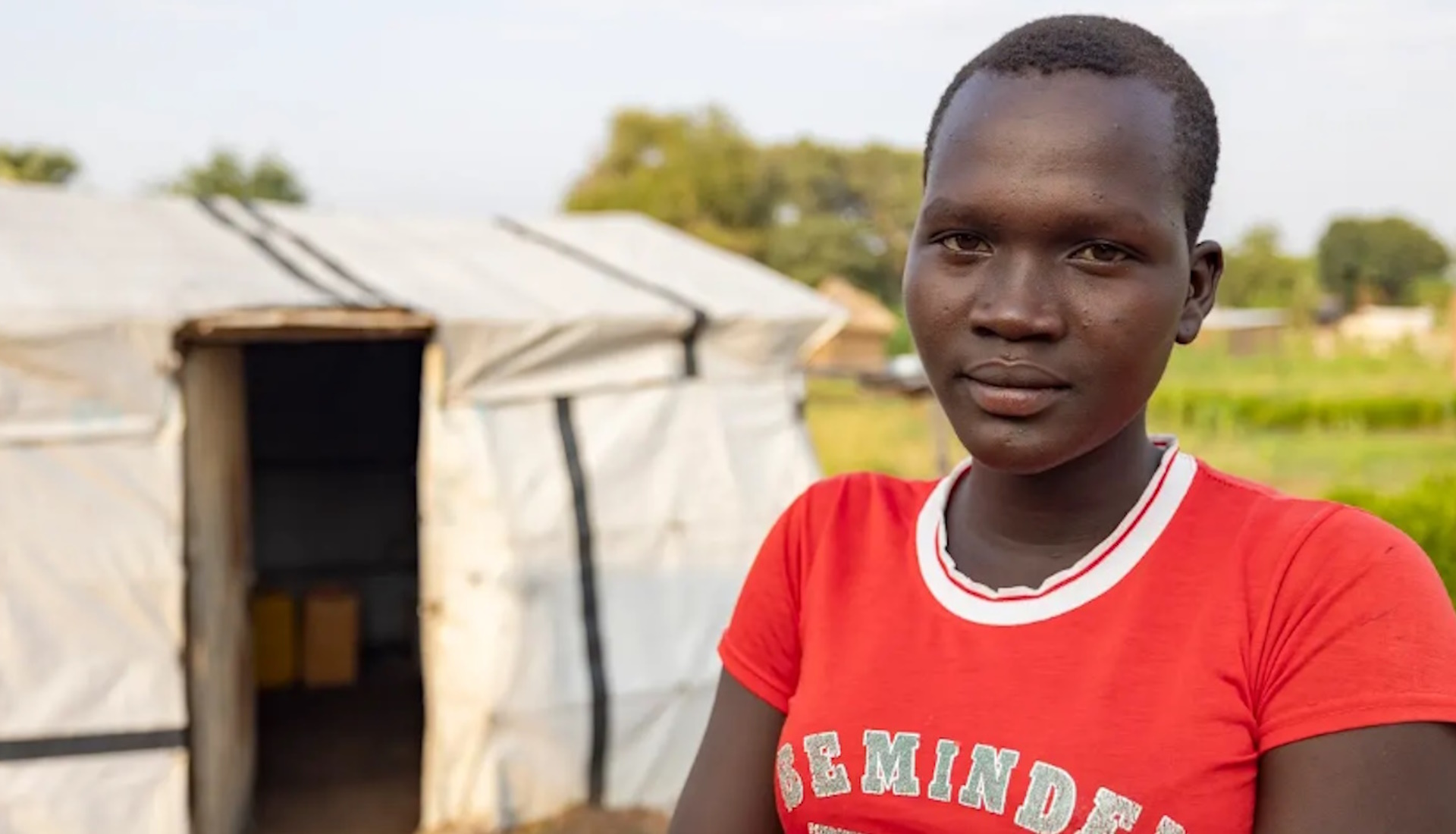
Rose has been the caregiver to her two young brothers since their mother abandoned them.
One of the most difficult decisions Rose and siblings had to make was to leave a home they had known since birth in South Sudan because of the insecurity the country was facing at the time.
Now settled at the Palorinya Refugee Settlement in Obongi district, Rose has engaged in all sorts of odd jobs, particularly digging other people’s gardens to put food on the table for herself and two younger siblings.
The trio were abandoned by their mother who opted to go back to their family farm. Rose also later learnt that her mother remarried and cut off communication, a move that made her the sole caretaker of her siblings.
Nine years ago, Rose’s father was killed in a flare-up of violence in South Sudan. Eventually her mother decided to flee to northern Uganda with Rose and her two younger sons.
Soon after the family’s arrival in the settlement, however, Rose’s mother abandoned them. “She went back to our farm in South Sudan, but we have not communicated since because we have no phone. We only heard that she remarried when she returned to South Sudan,” says Rose.
Now, at age 17, Rose has been the caregiver to her two younger brothers, Julius (15) and Brian (9), for the last five years.
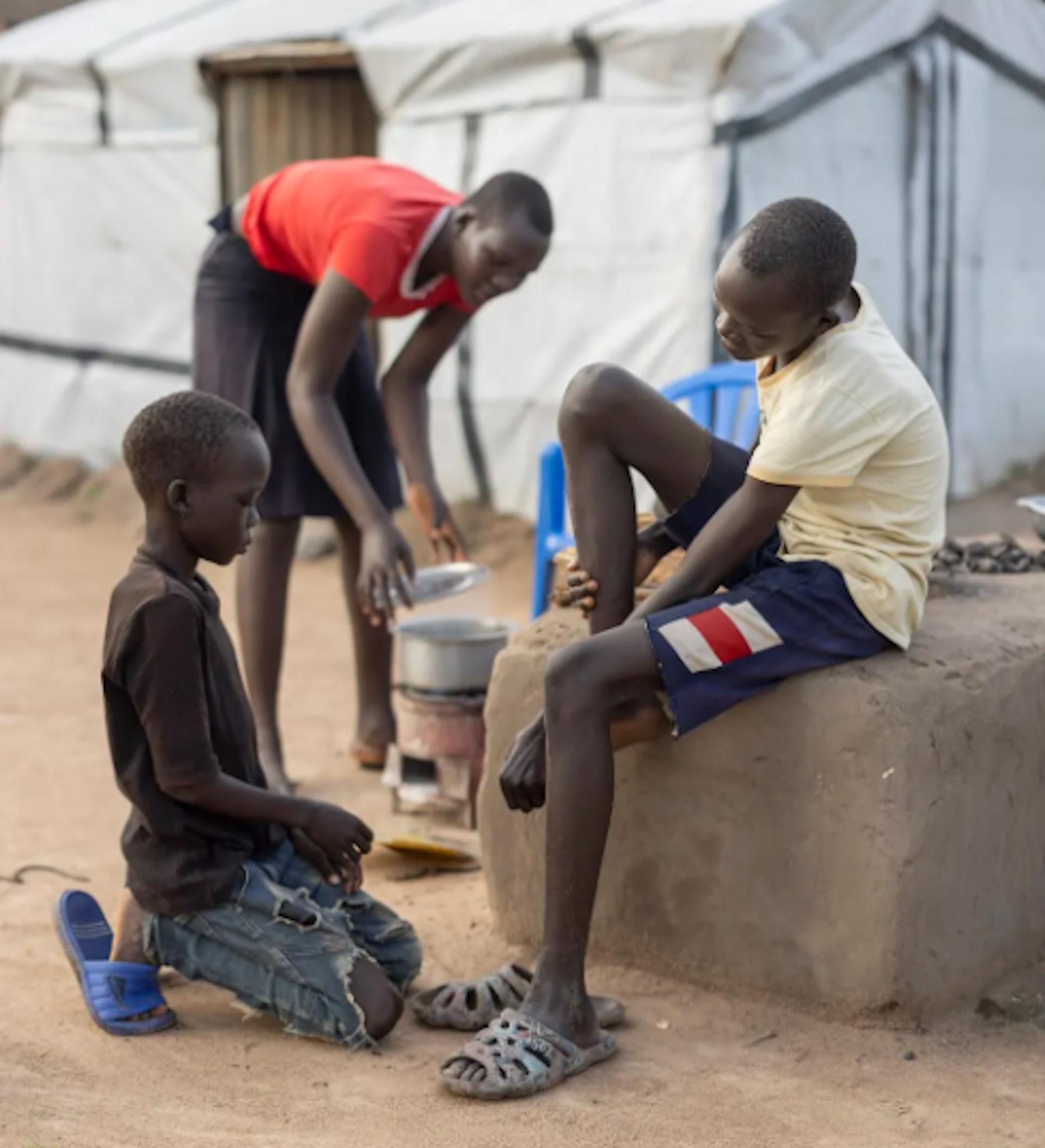 Rose and brothers at the Palorinya settlement.
Life at the settlement was gruelling. Although the family received small food rations from the World Food Programme including beans, maize flour, salt and oil, they were never enough to sustain them.
Rose took on whatever work she could find, digging gardens, washing clothes, fetching water, just to keep her siblings fed. While other children her age attended school, she sacrificed her education to ensure her brothers could stay in class. “I engage in casual work to raise money for home. If there is nothing, I let my brothers know and we just sleep hungry,” she said.
Rose’s hard work enabled Julius and Brian to attend school here in Uganda, even if she couldn’t.
However, with support from ChildFund’s Male Action Group, Rose obtained psychosocial counselling and guidance that helped her settle in and resume school.
“They advised me to return to school,” she recalls. “They said staying at home during school days is bad. They said children should go to school to help themselves, their parents and their future.”
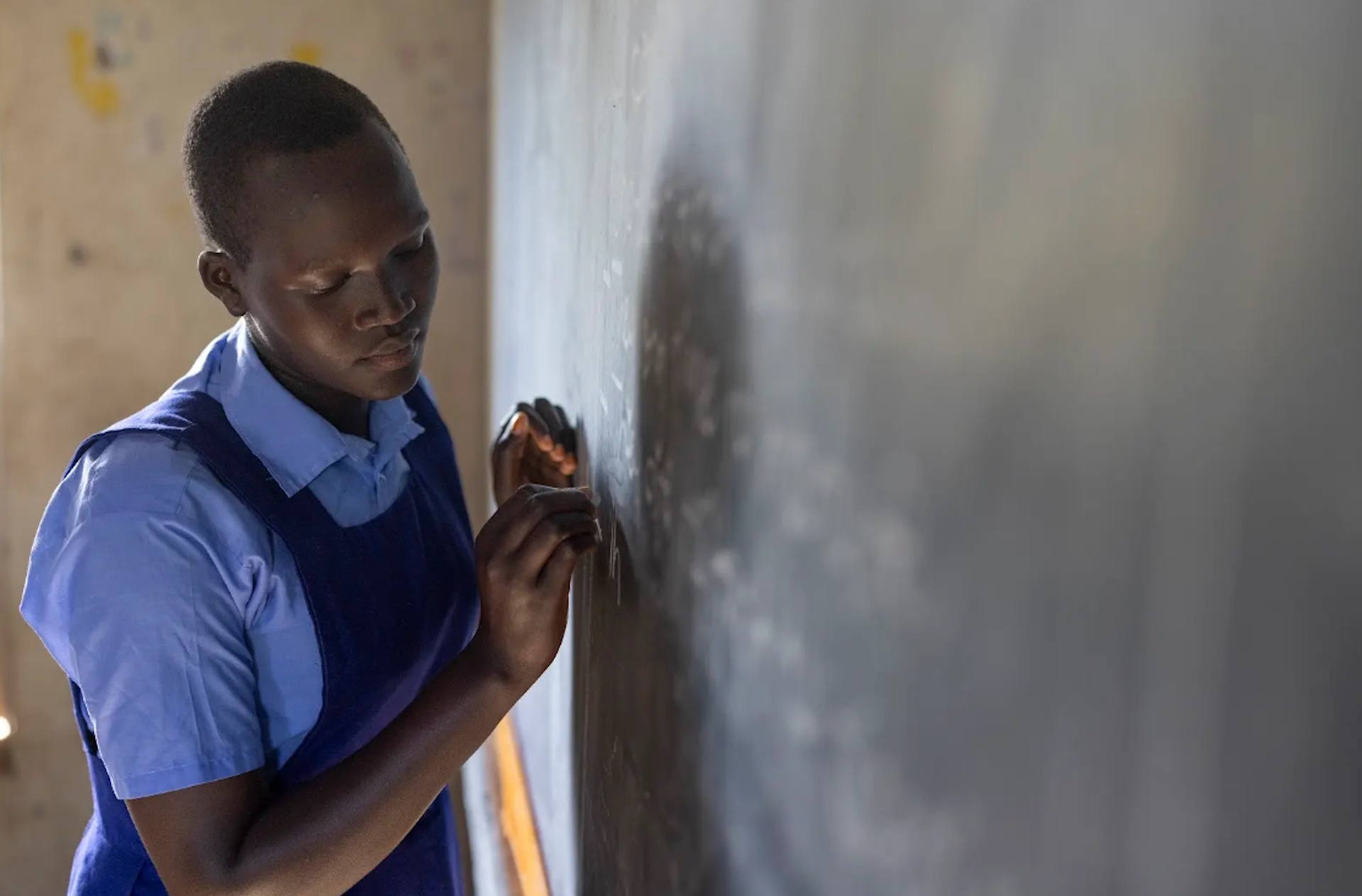 Rose writing on the blackboard. She loves school and hopes to build a better for herself and siblings.
After a series of visits and discussions, as well as a meeting with the local school headmaster, Rose agreed to start school.
Andrew Kaya, one of the Male Action Group members who counselled Rose says they traverse through homes at the settlement to offer support to families that are struggling and have lost hope.
“I advised Rose that she still has a long life ahead to change her story,” Kaya said, adding that those who heed the advice change their lives.
A refugee too, Kaya can hardly provide physical aid to the families he and his group mates visit. But seeing as their situation was quite unique, the group mobilised and set up a second small house for Rose’s siblings to share. It was later roofed by well-wishers.
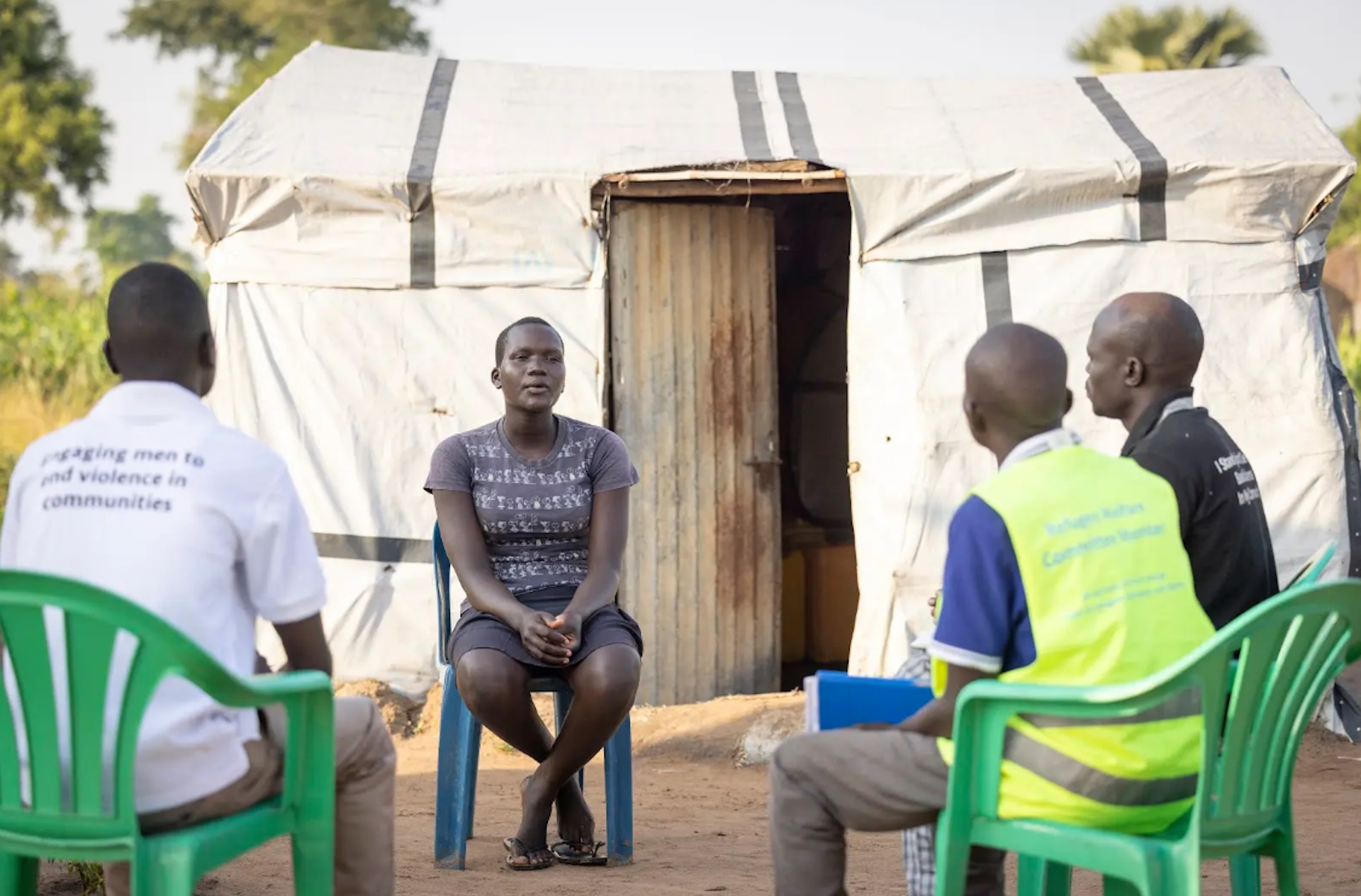 Kaya (in black) along with members from the Male Action Group visiting Rose to guide and counsel her.
The three previously shared one mattress in a tiny room and this did not accord Rose privacy as a young girl.
However, unlike before, Rose sees these hardships as something only temporary. “I know now that education is important to me.If I do not study, who is going to help me?” she shared.
Rose aspires to become a nurse in future.
The Palorinya Refugee Settlement in northern Uganda is home to 125,000 refugees and asylum seekers (UNHCR, June 2023) who have fled conflict in neighboring countries such as South Sudan.
Families who seek safe haven here are assigned a 20- by 30-meter plot of land on which to construct a housing compound and raise a small vegetable garden.
Many child-headed households exist in the settlement due to caregivers leaving the camp to find food or a source of income elsewhere in Uganda or by returning to South Sudan for extended stays.
Even adult caregivers living in the settlement are often not present near the home during the day, venturing far outside the camp to search for their livelihoods.
ChildFund works in the Palorinya Refugee Settlement by providing three child-friendly spaces for children and youth, and through training community leaders on and promoting awareness about violence against girls, boys, men and women and child protection issues.
ChildFund’s child-friendly spaces in the settlement are fenced-in compounds, each with a classroom block, improved toilets and a playground so that children have a safe place to play, learn and interact with one another each day.
To create awareness throughout the community around violence and child protection issues, ChildFund established and trained Male Action Group committees and also disseminates information over the radio.


Related Resources

A backpack innovation supporting children carry less and learn more
Until recently, fetching water was one of the hardest parts of Samuel's day.

New ‘jerrybags’ ease water burden for refugee schoolchildren in Northern Uganda
Before the school bell rings, many children in Palorinya Refugee Settlement have already walked several...

Harnessing technology to expand access to SRH information for youth
Over 20,000 young people across Uganda will now have easier access to accurate, confidential and...